
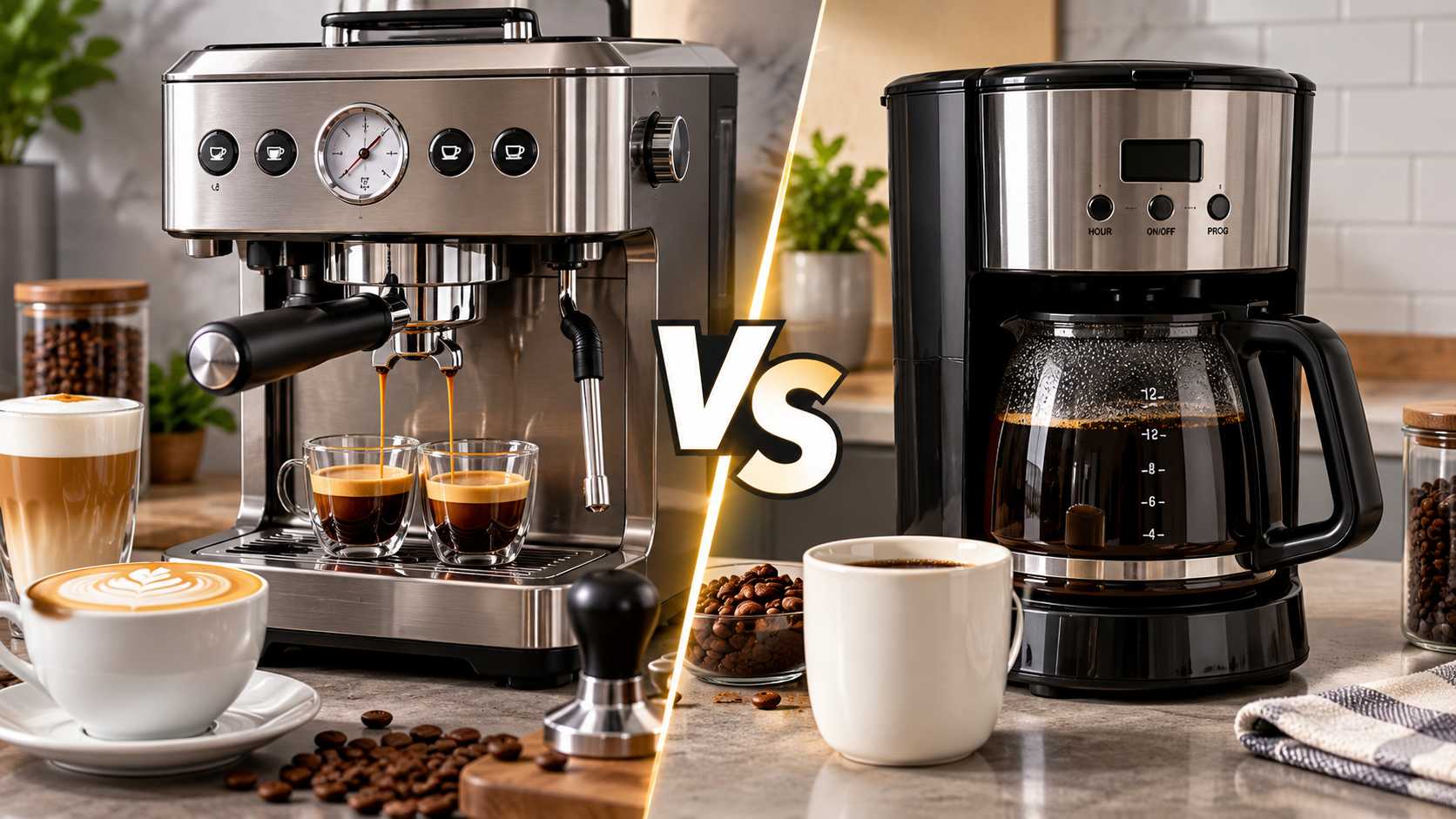
If you are comparing an espresso machine vs coffee maker, the biggest difference is how each one brews coffee. An espresso machine uses finely ground coffee and pressure to produce a small, concentrated drink, while a typical drip coffee maker uses gravity to pass hot water through coffee grounds and produces a larger, milder cup.
Neither option is automatically better. The right choice depends on the coffee you enjoy, how much time you want to spend preparing it, your budget, and whether you want to make drinks such as lattes and cappuccinos.
This guide compares the key differences between espresso machines and coffee makers so you can decide which type better fits your daily routine.
Espresso Machine vs Coffee Maker: Quick Comparison
| Feature | Espresso Machine | Coffee Maker |
|---|---|---|
| Brewing method | Pressure-based extraction | Gravity/drip brewing |
| Typical grind | Fine | Medium |
| Drink size | Small, concentrated shot | Larger cup |
| Flavor | Concentrated and intense | Milder and less concentrated |
| Preparation | More involved | Usually simpler |
| Milk drinks | Possible with suitable milk system | Usually requires separate equipment |
| Initial cost | Often higher | Often lower |
| Cleaning | Generally more involved | Usually simpler |
| Learning curve | Moderate to high depending on machine | Generally low |
These are general differences. Features vary considerably among individual machines.
What Is an Espresso Machine?
An espresso machine is designed to force hot water through finely ground coffee under pressure.
The result is a small, concentrated serving of coffee that can be consumed on its own or used as the base for drinks such as cappuccinos, lattes, flat whites, and Americanos.
Espresso machines range from hands-on manual and semi-automatic models to automatic and super-automatic machines that handle much of the brewing process.
If you are still deciding between these different types, our guide to choosing an espresso machine explains the main factors to consider before buying.
What Is a Coffee Maker?
The term coffee maker can describe several brewing devices, but in everyday use it often refers to an automatic drip coffee maker.
A drip coffee maker heats water and distributes it over ground coffee held in a filter. The brewed coffee then passes through the filter and collects in a carafe or cup.
The process is generally straightforward and works particularly well when you want to prepare several cups at once.
1. Brewing Method
The fundamental difference between an espresso machine and a drip coffee maker is the extraction method.
Espresso Machine
Espresso brewing uses pressure to move hot water through a compact bed of finely ground coffee.
Because the extraction happens differently from drip brewing, espresso is concentrated and served in relatively small portions.
Coffee Maker
A drip coffee maker relies primarily on gravity. Hot water flows through the coffee grounds and filter before entering the carafe.
This produces a larger volume of brewed coffee rather than a concentrated espresso shot.
The two methods are therefore not simply different ways of producing exactly the same drink.
2. Taste and Coffee Strength
Espresso typically has a concentrated flavor and fuller body because a relatively small amount of water is used for the extraction.
Drip coffee generally has a lighter concentration and is consumed in a larger serving.
However, stronger-tasting coffee does not necessarily mean that one brewing method is objectively better. Roast level, coffee freshness, grind size, coffee-to-water ratio, water quality, and preparation all influence the final cup.
Your preference matters more than choosing whichever machine appears more powerful.
3. Grind Size
Espresso generally requires a much finer grind than drip coffee.
The grind must also be reasonably consistent because small changes can noticeably affect espresso extraction.
Drip coffee usually uses a medium grind, although the ideal setting depends on the brewer and filter.
This distinction matters when buying equipment. If you choose a semi-automatic espresso machine without a built-in grinder, you may also need a grinder capable of making sufficiently fine and adjustable coffee grounds.
For drip coffee, grinder requirements are often less demanding.
4. Brewing Time
An individual espresso shot can be prepared quickly once the machine is heated and the coffee has been prepared.
However, the complete workflow may include:
- Grinding
- Dosing
- Distributing
- Tamping
- Brewing
- Steaming milk
- Cleaning the portafilter and steam wand
A drip coffee maker usually requires less hands-on work. You add water and coffee, start the machine, and allow it to brew.
For households making several cups at once, a drip coffee maker can therefore be particularly convenient.
5. Ease of Use
Coffee makers generally have the advantage when simplicity is the priority.
Many drip machines require little more than water, ground coffee, a filter, and the press of a button.
Espresso machines vary significantly.
A semi-automatic machine requires more user involvement and some practice. Automatic machines reduce certain manual steps, while super-automatic machines can automate grinding, dosing, brewing, and sometimes milk preparation.
Therefore, when comparing ease of use, it is important to consider the specific type of espresso machine rather than treating all espresso machines as identical.
6. Cost
Drip coffee makers are available across a wide range of prices, including many relatively inexpensive models.
Espresso equipment can require a larger initial investment, particularly when a separate espresso-capable grinder is needed.
The total cost may include:
- Espresso machine
- Coffee grinder
- Tamper
- Scale
- Milk pitcher
- Cleaning products
- Water filters
- Replacement parts or maintenance
A machine with an integrated grinder can simplify the setup, although integrated and separate grinders each have advantages.
The important comparison is therefore total setup cost, not simply the price displayed on the machine.
7. Cleaning and Maintenance
Both types of machines require cleaning, but espresso equipment usually involves more routine maintenance.
An espresso workflow may require cleaning the portafilter, basket, group area, drip tray, steam wand, and water system.
Depending on the machine, periodic descaling, cleaning cycles, or water-filter replacement may also be required.
A drip coffee maker typically requires cleaning of the carafe, filter basket, water system, and other removable components, along with periodic descaling.
If minimal maintenance is one of your highest priorities, this difference should influence your decision.
8. Types of Drinks You Can Make
This is one of the biggest practical differences.
With an Espresso Machine
Depending on the machine and its milk system, you can prepare drinks such as:
- Espresso
- Americano
- Cappuccino
- Latte
- Flat white
- Macchiato
Espresso therefore provides a versatile base for many café-style drinks.
With a Coffee Maker
A conventional drip coffee maker primarily produces brewed coffee.
You can change beans, roast levels, coffee-to-water ratios, and serving styles, but the machine is not designed to produce traditional espresso.
If you mostly drink a large cup of black coffee in the morning, that may be exactly what you need.
Espresso Machine vs Coffee Maker: Which Should You Choose?
The better choice depends on your routine rather than on which appliance has more features.
Choose an Espresso Machine If:
- You prefer espresso and espresso-based drinks.
- You regularly drink cappuccinos or lattes.
- You enjoy experimenting with coffee preparation.
- You want greater control over the brewing process.
- You are comfortable with additional cleaning and maintenance.
- You are willing to budget for an appropriate grinder when necessary.
If this describes your needs, our Best Espresso Machines Consumer Guide can help you compare specific options.
Choose a Coffee Maker If:
- You mainly drink regular brewed coffee.
- You want to prepare several cups at once.
- Simplicity is a priority.
- You prefer a lower-maintenance routine.
- You do not regularly make espresso-based milk drinks.
- You want a straightforward morning brewing process.
For many households, convenience can be more valuable than having additional brewing controls.
Can You Make Espresso With a Regular Coffee Maker?
A conventional drip coffee maker does not produce traditional espresso because it uses a different extraction method.
You can make stronger drip coffee by changing the coffee-to-water ratio, but stronger brewed coffee and espresso are not the same beverage.
If espresso is what you specifically want, use equipment designed for espresso extraction rather than choosing a drip machine based on the expectation that it will produce the same result.
Can One Machine Replace Both?
It depends on what you expect from each brewing method.
Some espresso machines can prepare Americanos by combining espresso with hot water. For someone who enjoys both espresso and longer coffee drinks, this may provide enough versatility.
However, an Americano is not identical to drip coffee.
Similarly, combination machines exist that incorporate more than one brewing method, but convenience, performance, counter space, cleaning, and cost should all be considered before choosing one.
Buying one machine with many functions is not necessarily better than choosing equipment that performs the functions you actually use well.
Frequently Asked Questions
Is espresso stronger than regular coffee?
Espresso is more concentrated in flavor and composition per unit of volume, but comparisons depend on serving size and how the coffee is prepared. A full serving of drip coffee and a single espresso shot are very different quantities.
Is an espresso machine worth buying for home use?
It can be worthwhile if you regularly drink espresso or espresso-based beverages and are comfortable with the cost, preparation, and maintenance involved. Someone who primarily drinks drip coffee may get more value from a good coffee maker.
Can I use regular coffee beans in an espresso machine?
Espresso is not limited to a special category of bean. Different beans and roast levels can be used, although grind size, freshness, dose, and extraction settings need to suit the machine and the desired result.
Which is easier to use: an espresso machine or coffee maker?
A conventional drip coffee maker is generally easier to operate. Espresso machines range from highly manual to highly automated, so ease of use varies considerably by machine type.
Do I need a grinder for an espresso machine?
You need appropriately ground coffee. Some espresso machines include a grinder, while others require a separate grinder. If you buy a machine without an integrated grinder, grinder capability should be considered as part of the overall setup.
Final Verdict
When comparing an espresso machine vs coffee maker, start with the drinks you actually enjoy.
Choose an espresso machine if you want concentrated espresso, café-style milk drinks, and greater involvement in the brewing process.
Choose a coffee maker if you primarily want larger servings of brewed coffee with a simpler workflow and generally less hands-on preparation.
Neither appliance is universally better. The right choice is the one that matches your coffee preferences, budget, available space, and willingness to spend time preparing and maintaining the equipment.
If espresso is the better fit for your routine, continue with our Best Espresso Machines Consumer Guide to compare specific machines.

Hi! I’m Emma
Welcome to Best Consumer Guides! I research and compare everyday products to help readers make informed buying decisions. My guides focus on practical features, usability, value, and reliable product information. My goal is to make product research simpler and help you find the right products for your needs.
1 thought on “Espresso Machine vs Coffee Maker: What’s the Difference?”