
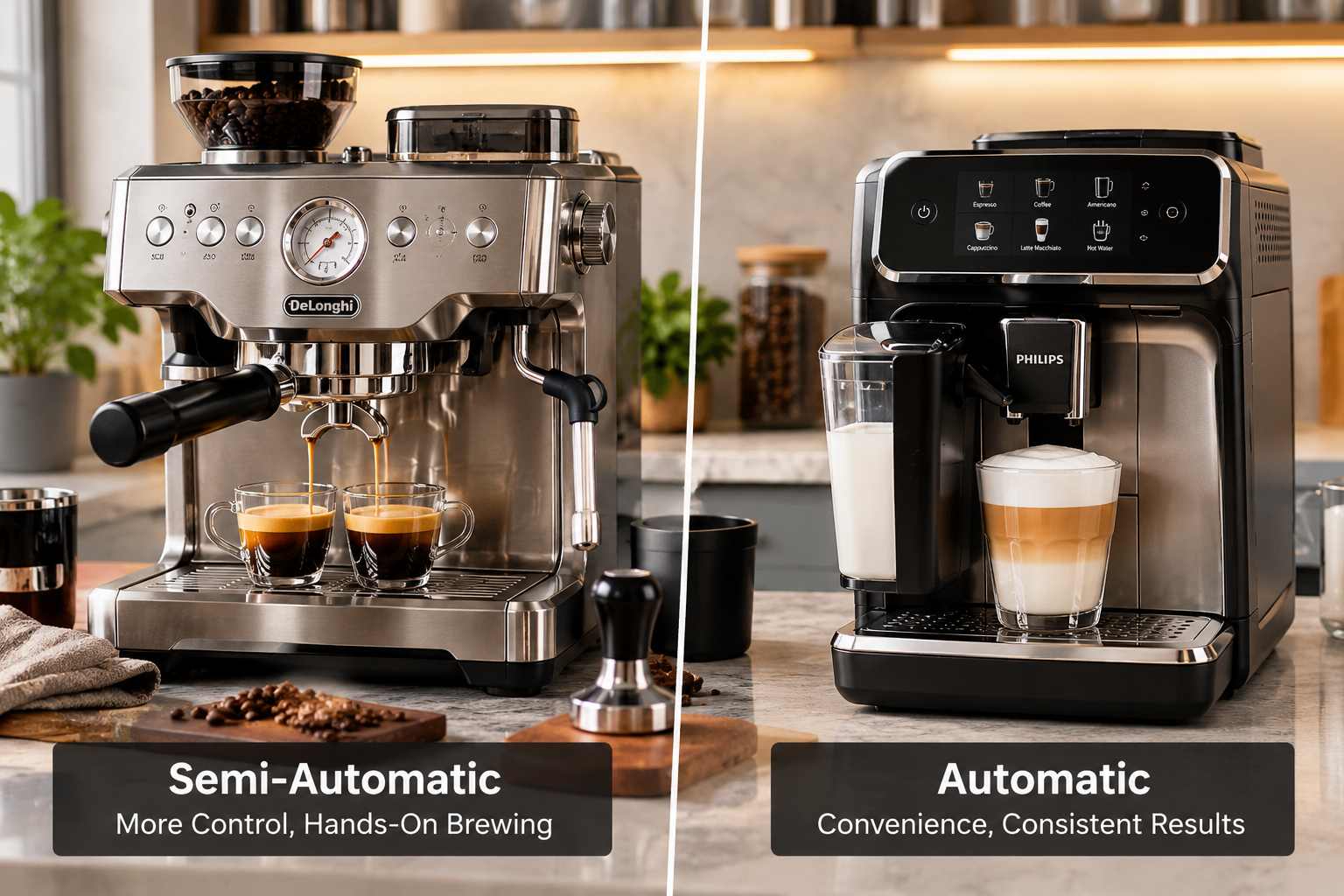
Choosing between a semi-automatic vs automatic espresso machine comes down largely to how much control you want over the brewing process and how much convenience you expect from your machine.
Semi-automatic machines typically give you more direct involvement in preparing and controlling each shot. Automatic machines automate part of the extraction process, making it easier to repeat similar drinks with less manual input.
Neither type is inherently better. The right choice depends on your experience, coffee preferences, daily routine, budget, and willingness to learn the espresso-making process.
This guide compares the two types so you can decide which approach better fits the way you make coffee at home.
Semi-Automatic vs Automatic Espresso Machine: Quick Comparison
| Feature | Semi-Automatic | Automatic |
|---|---|---|
| Brewing control | Higher | More automated |
| Shot stopping | User controlled | Usually programmed |
| Learning curve | Higher | Lower |
| Consistency | Depends more on technique | Easier to repeat |
| User involvement | Higher | Lower |
| Customization | Generally greater | Depends on machine |
| Convenience | Moderate | Higher |
| Best suited for | Hands-on users | Convenience-focused users |
The distinction can vary somewhat between manufacturers, so always check how a particular machine actually operates rather than relying only on its category name.
What Is a Semi-Automatic Espresso Machine?
A semi-automatic espresso machine gives the user direct control over several important parts of espresso preparation.
You will typically grind the coffee, dose it into the portafilter, distribute and tamp the grounds, start the extraction, and decide when to stop it.
The machine provides the pressure required for brewing, but the user remains actively involved in preparing the coffee and controlling the shot.
This makes semi-automatic machines popular among people who enjoy learning how grind size, dose, extraction time, and other variables affect the final cup.
What Is an Automatic Espresso Machine?
An automatic espresso machine is similar in many ways to a semi-automatic machine, but it generally automates the amount of water delivered during extraction.
Instead of manually deciding when to stop every shot, you can typically select a programmed volume and allow the machine to stop the extraction automatically.
You may still need to grind, dose, distribute, tamp, and steam milk depending on the particular machine.
This is important because an automatic espresso machine is not necessarily the same as a super-automatic machine. Super-automatic machines usually automate considerably more of the complete coffee-making process.
If you are still learning the broader differences among espresso machine types, our guide to choosing an espresso machine explains manual, semi-automatic, automatic, and super-automatic options in more detail.
1. Brewing Control
Control is one of the clearest differences between these two machine types.
Semi-Automatic Machines
With a semi-automatic machine, you decide when the extraction starts and stops.
This gives you greater opportunity to adjust your technique based on the coffee, grind setting, dose, and desired result.
For someone interested in learning espresso preparation, that involvement can be an advantage.
However, greater control also means greater responsibility for consistency.
Automatic Machines
Automatic machines reduce one variable by controlling the programmed shot volume.
This can make the daily workflow easier and may help users produce more repeatable drinks once the machine has been configured appropriately.
You still retain control over other variables on many machines, but you do not necessarily need to monitor every extraction to stop it manually.
2. Ease of Use
Automatic machines generally have an advantage when ease of use is the priority.
Once your preferred settings are programmed, making repeated drinks can require less attention.
Semi-automatic machines demand more involvement. New users may need time to learn how changes in grind size, dose, distribution, tamping, and extraction affect the result.
That learning process can be enjoyable for enthusiasts, but it may be unnecessary for someone who simply wants a convenient morning espresso.
Ask yourself a practical question:
Do you want espresso preparation to be part of the experience, or do you mainly want the finished drink?
Your answer can make the choice considerably easier.
3. Consistency
Automatic shot dosing can make it easier to repeat the same programmed volume from one drink to the next.
That does not mean an automatic machine guarantees identical espresso every time. Coffee freshness, grind size, dose, distribution, and other factors still influence extraction.
A skilled user can achieve excellent consistency with a semi-automatic machine as well.
The main difference is that an automatic machine removes one manual step from the process, while a semi-automatic machine leaves more of the extraction timing in your hands.
4. Learning Curve
Semi-automatic machines generally have a steeper learning curve.
You may need to learn how to:
- Adjust grind size
- Dose coffee consistently
- Distribute grounds evenly
- Tamp consistently
- Observe extraction
- Adjust shot timing
- Steam milk
These skills develop with practice.
Automatic machines can reduce some of this workload, particularly the need to manually stop the extraction. However, traditional automatic machines can still require substantial user involvement.
If you want almost the entire process automated, you may actually be looking for a super-automatic machine rather than simply an automatic one.
5. Espresso Customization
Semi-automatic machines tend to appeal to users who enjoy experimenting.
Because you control more of the process, it is easier to intentionally adjust extraction based on different beans, roast levels, recipes, and personal preferences.
Automatic machines can also provide substantial customization depending on the model. Some allow users to program shot volumes, temperatures, pre-infusion settings, or other parameters.
Therefore, do not assume that “automatic” means you lose all control.
The better question is whether the particular machine provides control over the variables that matter to you.
6. Milk-Based Drinks
Both semi-automatic and automatic espresso machines may include steam wands or other milk systems.
If you regularly make cappuccinos, lattes, or flat whites, pay attention to the milk system rather than focusing only on how the espresso shot is controlled.
Consider:
- Steam power
- Steam-wand design
- Manual versus assisted steaming
- Warm-up time
- Ability to brew and steam efficiently
- Ease of cleaning
For frequent milk-drink users, these factors can influence the daily experience as much as automatic shot dosing.
7. Speed and Daily Workflow
The difference in actual brewing time may not be dramatic, but automatic dosing can make the workflow more convenient.
With a semi-automatic machine, you generally need to pay attention to the extraction and stop it yourself.
With an automatic machine, you can start a programmed shot and use those seconds for another part of drink preparation.
This may seem like a small advantage, but it can become useful when preparing several drinks each morning.
For one occasional espresso, the difference may matter much less.
8. Cleaning and Maintenance
Both machine types require regular cleaning.
Typical maintenance may include:
- Cleaning the portafilter and basket
- Flushing the group area
- Emptying the drip tray
- Cleaning the steam wand
- Descaling when appropriate
- Replacing water filters
- Following manufacturer cleaning cycles
An automatic shot function does not eliminate these tasks.
Cleaning requirements depend more on the specific machine design and milk system than simply whether the machine is classified as semi-automatic or automatic.
Before buying, check whether the components you will clean frequently are easy to remove and access.
9. Cost
Both categories cover a wide range of prices.
Automatic controls can increase complexity and cost, but machine category alone does not determine value.
Build quality, temperature management, boiler configuration, grinder integration, milk system, programmability, materials, and brand positioning can all influence price.
Also remember to consider the complete espresso setup.
If the machine does not include a grinder, you may need to budget for an espresso-capable grinder separately.
The most expensive machine is not necessarily the best match for your routine.
10. Semi-Automatic vs Automatic Espresso Machine: Which Should You Buy?
Your priorities should determine the answer.
Choose a Semi-Automatic Espresso Machine If:
- You enjoy hands-on coffee preparation.
- You want greater involvement in extraction.
- You want to develop espresso-making skills.
- You enjoy experimenting with different beans and recipes.
- You do not mind a learning curve.
- Espresso preparation itself is part of the experience for you.
Choose an Automatic Espresso Machine If:
- You want a simpler daily workflow.
- You value repeatable programmed shot volumes.
- Several people will use the machine.
- You prefer less attention during extraction.
- You want some control without manually managing every shot.
- Convenience is more important than maximum hands-on involvement.
If you are ready to compare specific models rather than machine categories, our Best Espresso Machines Consumer Guide provides a broader starting point.
Semi-Automatic, Automatic, or Super-Automatic?
These terms can create confusion.
A simple way to think about them is:
Semi-automatic: the user controls when extraction stops.
Automatic: the machine can stop extraction based on a programmed volume.
Super-automatic: the machine automates much more of the process and may grind, dose, brew, and manage milk preparation depending on the model.
The exact terminology can vary among brands and retailers, so evaluate the actual functions of a machine before purchasing.
If you are deciding whether espresso equipment is appropriate at all, our espresso machine vs coffee maker comparison explains how espresso machines differ from conventional drip coffee makers.
Frequently Asked Questions
Is an automatic espresso machine better than a semi-automatic?
Not necessarily. Automatic machines offer greater convenience during extraction, while semi-automatic machines give the user more direct control. The better option depends on your preferred workflow.
Do automatic espresso machines still require a grinder?
Some have integrated grinders, while others do not. If the machine does not include one, you will need appropriately ground coffee or a suitable separate grinder.
Are semi-automatic espresso machines difficult to use?
They require more practice than highly automated machines, but the basic workflow can be learned. Achieving consistent results usually takes additional experience and adjustment.
Does an automatic espresso machine make cappuccino automatically?
Not necessarily. “Automatic” may refer primarily to automated shot dosing. Milk preparation depends on the machine’s specific milk system. Check the actual features rather than relying on the word automatic alone.
Is a super-automatic espresso machine the same as an automatic machine?
Generally, no. A super-automatic machine usually automates substantially more of the process, potentially including grinding, dosing, brewing, and milk preparation.
Final Verdict
The choice between a semi-automatic vs automatic espresso machine is primarily a choice between greater hands-on control and greater convenience.
A semi-automatic machine makes sense if you want to participate actively in espresso preparation, develop your technique, and experiment with extraction.
An automatic machine makes sense if you prefer programmed shot volumes and a more convenient, repeatable workflow while still retaining many elements of traditional espresso preparation.
Before buying, consider not only the machine category but also the grinder, milk system, cleaning requirements, available space, and the drinks you make most often.
Once those priorities are clear, choosing between semi-automatic and automatic becomes much easier.

Hi! I’m Emma
Welcome to Best Consumer Guides! I research and compare everyday products to help readers make informed buying decisions. My guides focus on practical features, usability, value, and reliable product information. My goal is to make product research simpler and help you find the right products for your needs.